Wooden Tetris Puzzle – Spatial Thinking & Fine Motor Tool
Wooden Tetris Puzzle – Spatial Thinking & Fine Motor Tool
Couldn't load pickup availability
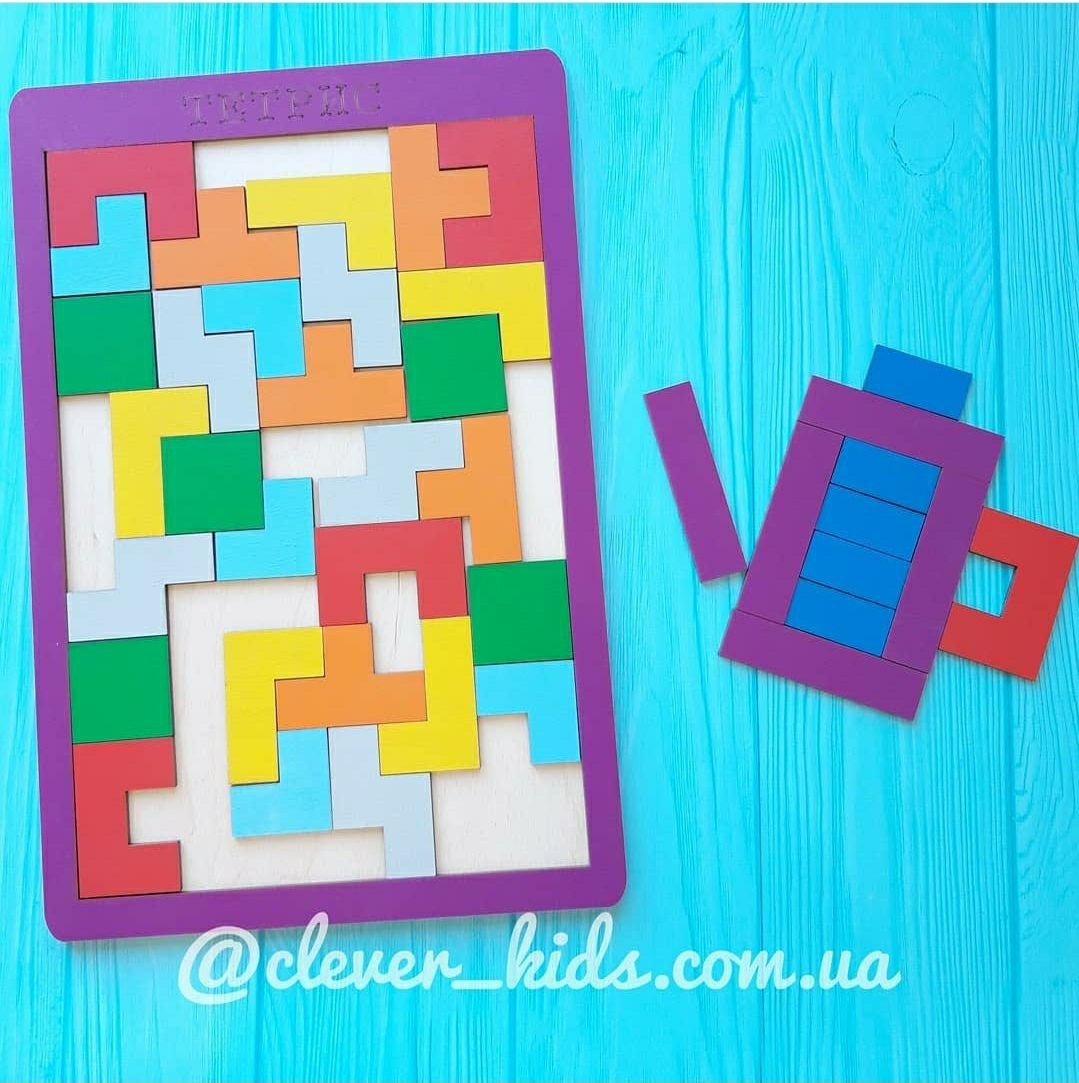
A flat plywood tetris puzzle that works in two directions: the pieces fit together inside the frame as one solved rectangle, or they come out and become free-form building material. That second use is what keeps it on the table after the first week — the child is not finished when the frame is full.
Each direction asks something different. Filling the frame is a closed task with one correct answer: it trains visual matching, trial and correction, and the patience to rotate a piece instead of forcing it. Building outside the frame is open — the child decides what to make, and the same pieces suddenly require planning rather than searching.
Ways to use it with a child
- Fill the frame. Take out two or three pieces to start, not all of them. Add one more each session as the child succeeds.
- Copy a pattern. You lay out a shape with a few pieces, the child reproduces it beside yours. Harder than free play, and it shows you exactly where attention breaks.
- Count the squares. Every tetris piece is made of squares — three, four, five. Counting them before placing turns the same set into early number work.
- Name the shapes. L, T, square, line. A child who can name a shape holds it in mind better than one who only recognises it.
- Sort before building. All pieces of one colour first, or all of one form. Sorting slows a child down enough that both the grip and the looking have to hold.
- Trace and colour. Each piece works as a stencil: the child holds it down with one hand and draws around it with the other, then colours the outline in. This is pencil control practice disguised as drawing, and it needs both hands doing different jobs — the same split handwriting requires later.
- Work on colour. Name the colours, group by colour, or ask for "the two yellow pieces" and let the child find them. Useful long before a child can name shapes.
- Build freely. No frame, no rules — a house, a robot, a pattern. Then ask the child to tell you what it is.
What it develops
Spatial reasoning and mental rotation, sustained attention, visual discrimination, early counting, pencil control through tracing, and the fine motor control of picking up and placing a thin flat piece with precision. For a child working with an occupational therapist or in a Montessori setting, one material covers several goals at once.
Specifications
- For adult-led work: the frame task suits a child from around two, tracing and counting from three to four
- Puzzle size: 30 × 20 cm
- Material: painted plywood
- Two uses: framed puzzle and free building
Made in small batches, sanded by hand, finished with child-safe paint. This is a tool for adult-led sessions, not a toy to hand over and walk away from. Worked through together, it suits a much younger child than the pieces alone would suggest.
Share