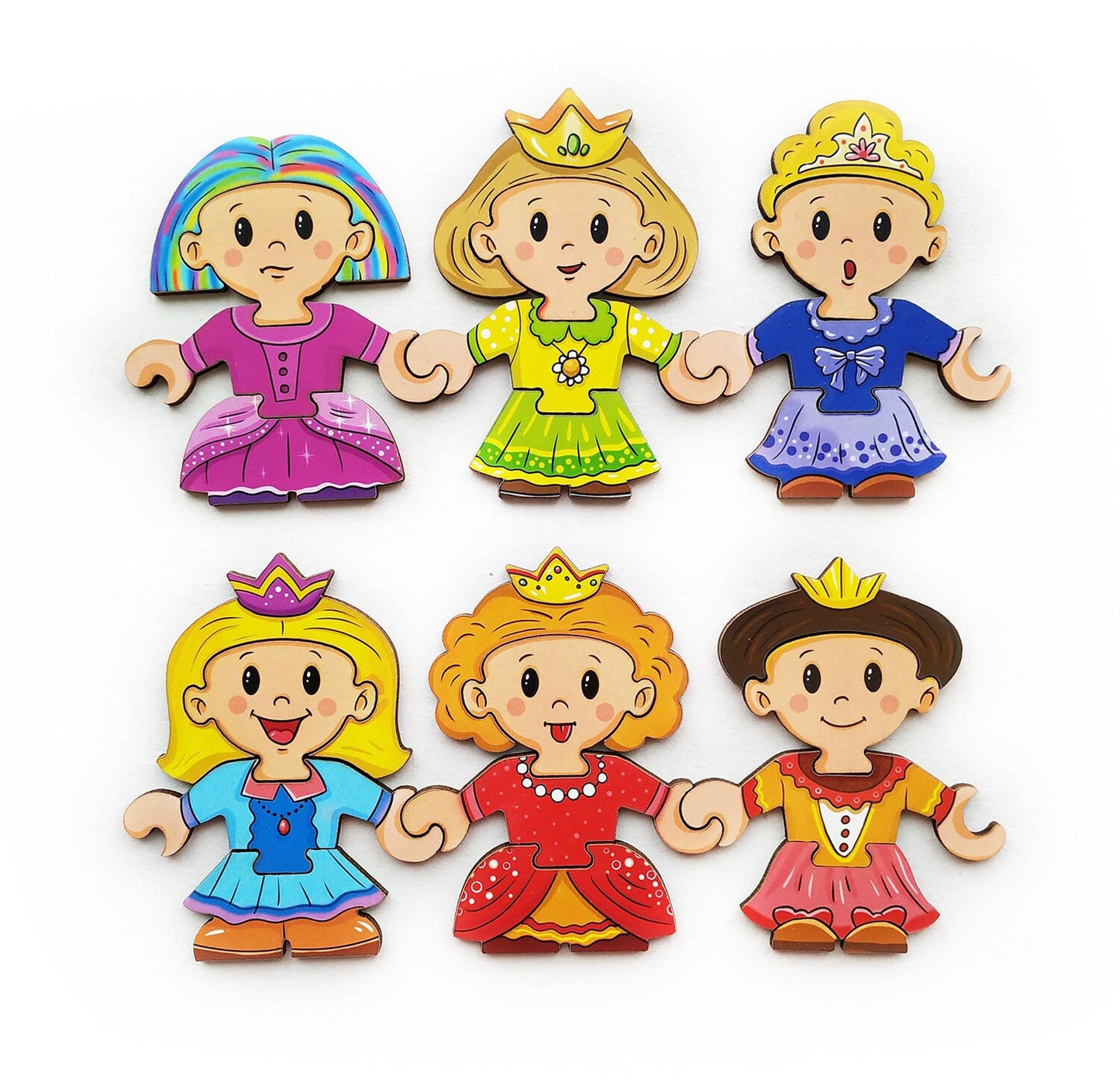
Wooden Princess Character Builder — Creative Role-Play Puzzle
Wooden Princess Character Builder — Creative Role-Play Puzzle
Couldn't load pickup availability
A board of interchangeable plywood pieces: faces with different expressions, hairstyles, gowns. Nothing is fixed, so no combination is the correct one. The child builds a figure, takes her apart and builds a different one from the same pieces.
The open format is the point. A puzzle with one solution ends when it is solved. Here the adult sets the task instead, which means the same board can be a naming exercise one day and a listening exercise the next. For a child who finds it easier to talk about a character than about themselves, a figure on the table is a safer place to put a feeling.
Ways to use it with a child
- Build, then change one thing. Assemble a princess together, then swap only the face. Ask what changed about her. Isolating one variable is what makes an expression noticeable.
- Find the feeling. Ask for the happy one, the surprised one, the sad one. Then make the face yourself and let the child copy it. Doing an expression with your own face is what connects the word to the feeling.
- Build from a description. You describe a princess out loud without pointing, the child builds her. Long hair, a red gown, a surprised face. This is listening and following instructions, and it gets hard quickly at three details.
- Ask why. Once a figure is built, ask what happened to make her feel that way. The answer is a story, and stories are where a child practises cause and effect.
- Trace and dress her. Use the finished figure as a stencil, then let the child draw a gown of their own design around the outline. One hand holds, the other draws.
- Swap roles. The child describes, you build. Being the one who gives the instructions is harder than following them, and it shows you how precise their language really is.
What it develops
Emotional vocabulary and recognising expressions, listening and following multi-step instructions, narrative language, cause and effect, pencil control through tracing, and the finger control to place a flat piece accurately. Used in play therapy and social-emotional learning, and often a good entry point for children who connect through fictional characters more readily than through direct questions.
Specifications
- For adult-led work: building and naming feelings suit a child from around three, building from a spoken description from four to five
- Board: 20 × 20 cm
- Material: painted plywood, interchangeable pieces
- Faces, hairstyles and gowns combine freely
Made in small batches, sanded by hand, finished with child-safe paint. This is a tool for adult-led sessions rather than something to hand over and walk away from. Worked through together, it suits a younger child than the pieces alone would suggest.
Share