Wooden Pirate Ship Puzzle — Vocabulary & Storytelling Toy
Wooden Pirate Ship Puzzle — Vocabulary & Storytelling Toy
Couldn't load pickup availability
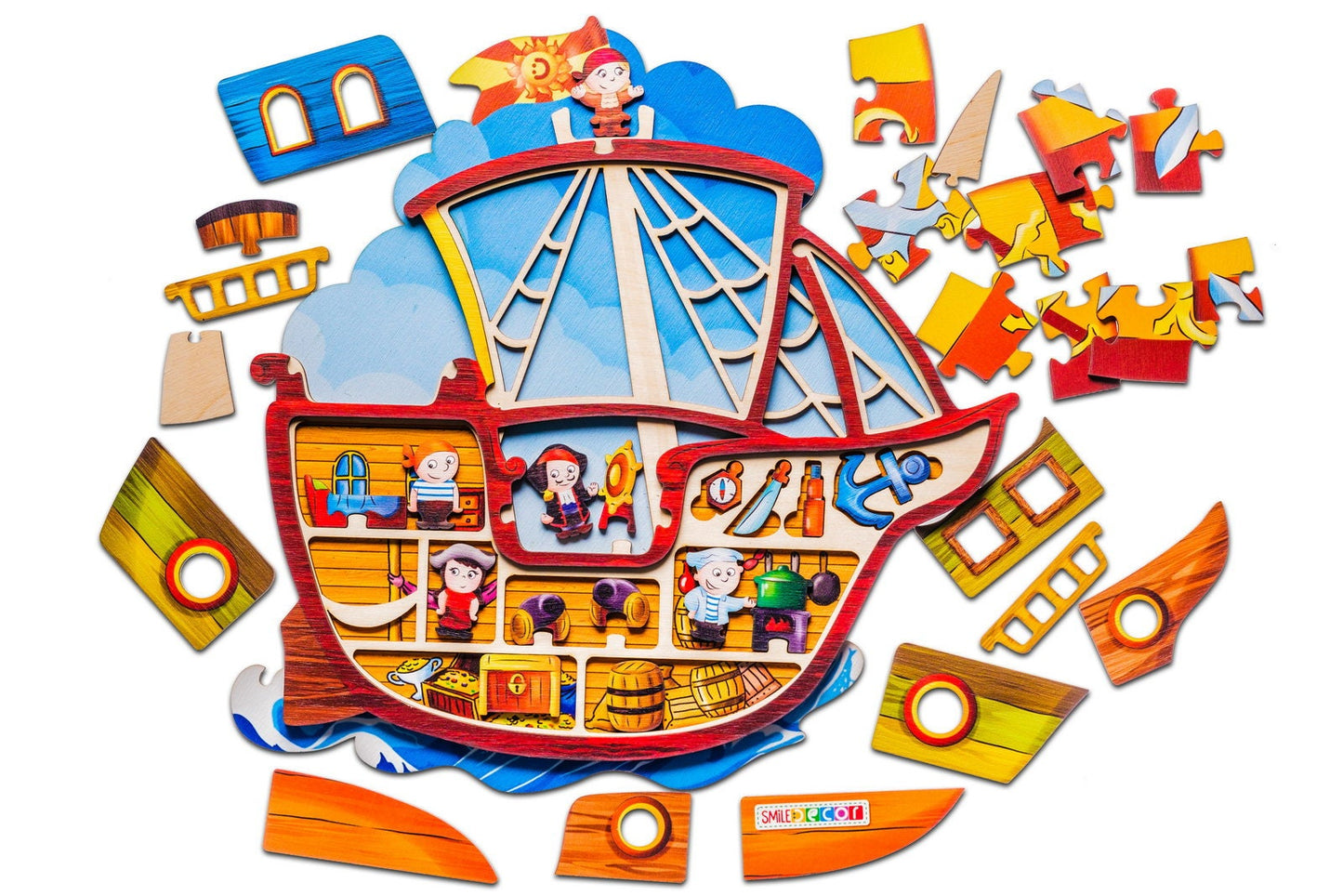
A layered plywood ship that comes apart into hull, deck, masts, sails and crew. Assembled it stands as one picture; taken apart it becomes a set of named objects, and that second state is where the language work happens.
Most puzzles run out of use once a child can complete them. This one keeps going because the pieces have names worth learning. A child who can say deck, hull, helm and anchor has words for parts of a whole, which is a harder category than object names and one that children with a language delay often skip. The ship gives those words something to point at.
Ways to use it with a child
- Name the parts first. Before assembling, hand over one piece at a time and name it: deck, sail, hull, helm, anchor. Naming a piece the child is holding sticks better than naming one on a page.
- Assemble by the picture. Build it once yourself so the child sees the finished ship, then take it apart and let them rebuild. Layers have an order, and working out which piece goes down first is the planning part of the task.
- What is missing? Lay out five to seven pieces, let the child look, then cover them and remove one. Asking which piece is gone is harder than asking what moved, and it is a clean way to see how much a child holds in mind.
- Give the crew jobs. Captain, navigator, sailor. Who decides where the ship goes? Who climbs the mast? Roles give a child a reason to use whole sentences instead of single words.
- Build a story one sentence each. You add a sentence, the child adds the next. Taking turns keeps the story moving when a child cannot carry a whole narrative alone yet.
- Sort the transport. Talk through what else carries people and cargo: cargo ship, ferry, fishing boat. Grouping by function rather than by looks is a step up in thinking.
- Trace the hull. The larger pieces work as stencils. One hand holds, the other draws, and the child ends up with a ship to colour in.
What it develops
Vocabulary for parts of a whole, narrative language and sentence building, working memory, visual attention, sequencing a layered assembly, and the finger control to seat a thin piece precisely. Speech and language therapists, occupational therapists and special educators use this kind of material with children who have a language delay, autism or ADHD, because the object gives an abstract word something concrete to attach to.
Specifications
- For adult-led work: naming and simple assembly suit a child from around three, memory games and storytelling from four to five
- Size: 28 × 29 cm
- Material: painted plywood, multi-layer construction
- Comes apart into hull, deck, masts, sails and crew figures
Made in small batches, sanded by hand, finished with child-safe paint. This is a tool for adult-led sessions rather than something to hand over and walk away from. Worked through together, it suits a younger child than the pieces alone would suggest.
Share