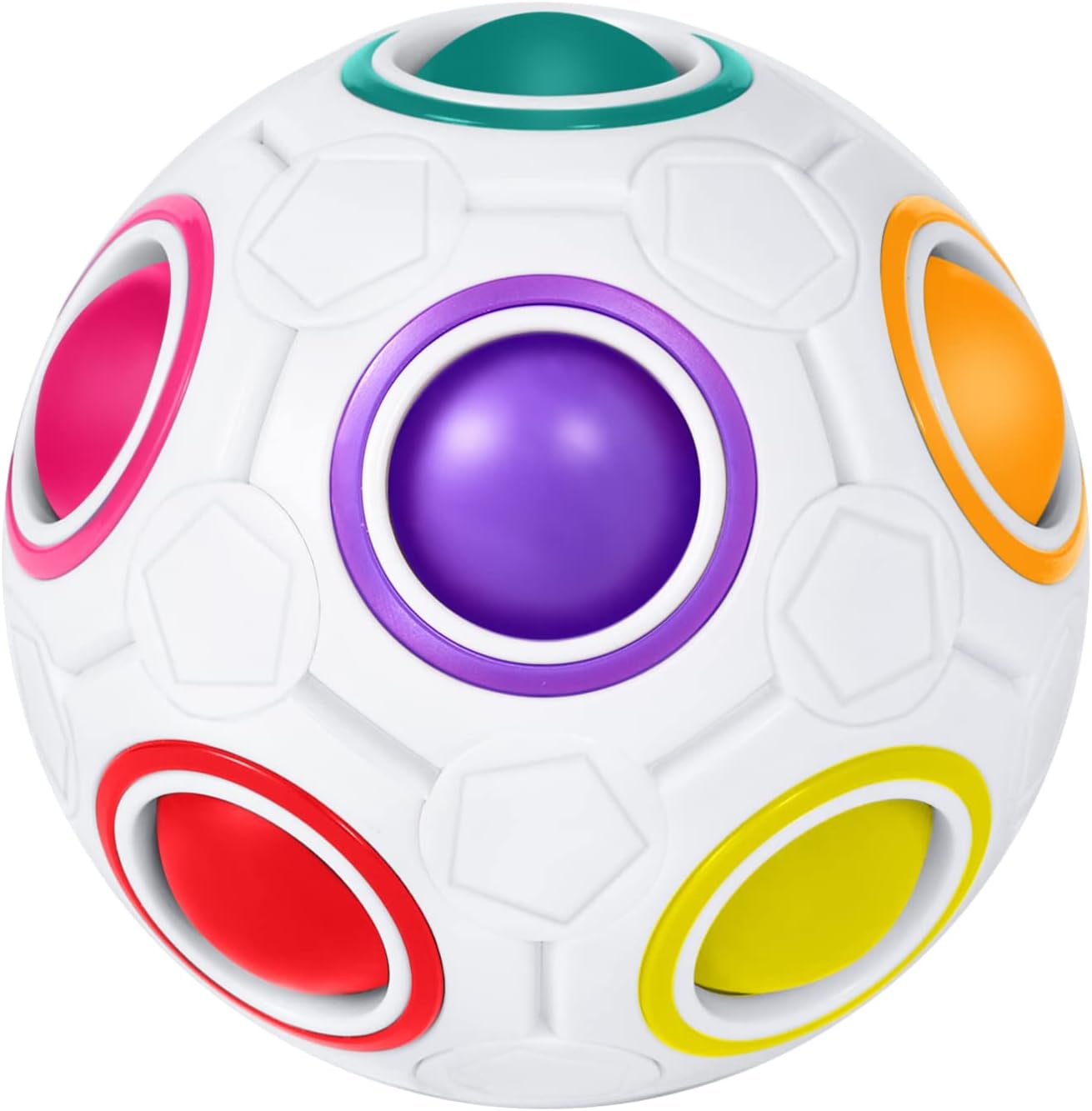
Rainbow Puzzle Ball – Finger Strength & Colour Matching Tool
Rainbow Puzzle Ball – Finger Strength & Colour Matching Tool
Couldn't load pickup availability
A 68 mm ball with twelve sockets and eleven coloured balls inside, which leaves one socket empty. A ball can only move into that empty space, so the puzzle is solved one press at a time until every ball sits in the ring that matches its colour.
The mechanism is a sliding tile puzzle wrapped around a sphere: one gap, and no way to move a ball except through it. What makes it worth more than the puzzle alone is the press itself. Each ball needs a firm push from a single fingertip, which is index finger isolation and finger strength, the same groundwork that tweezer work and pencil grip depend on. A child will do it voluntarily for twenty minutes in a car, and that is not true of most fine motor practice.
Ways to use it with a child
- Start with two balls out of place. Solve the ball yourself, then move only two. Handing over a fully scrambled ball is where a child decides the thing is impossible.
- Name the colour before pressing. Which ball are you moving, and where is it going? Saying it out loud slows the hand down enough for the plan to catch up.
- One finger only. Index finger, no thumb, no palm. That single rule turns a fidget into fine motor work, and it is the reason the ball earns a place beside the wooden materials.
- Look for the empty hole first. A child who hunts for the gap before choosing a ball is planning; one who presses at random is not. This is the one hint worth giving.
- Count the presses. Solve it, then try again in fewer moves. Counting turns a finished puzzle back into a problem without changing anything about it.
- Keep it for waiting. Car, waiting room, queue. Hand it over at the start of the wait rather than after a child has already run out of patience.
What it develops
Index finger isolation and finger strength, planning a sequence of moves, colour matching, sustained attention on a task with a clear finish, and self-regulation in the kind of waiting where a child has nothing else to do. Occupational therapists use puzzles of this type for finger strength, and the enclosed design means nothing comes loose or gets lost under a car seat.
Specifications
- For adult-led work: colour matching suits a child from around four, solving the whole ball from five to six
- Diameter: 68 mm, fits a coat pocket
- Eleven coloured balls, twelve sockets, one deliberately empty
- Material: ABS plastic with a soft internal core, nothing detaches
This is the one item in our catalogue that is plastic rather than wood, and the one a child works on alone rather than with an adult at the table. It is here for the car and the waiting room, where a wooden puzzle is not practical and a screen is the usual alternative.
Share