Wooden Cat Tree Puzzle – Sorting, Logic & Language Tool
Wooden Cat Tree Puzzle – Sorting, Logic & Language Tool
Couldn't load pickup availability
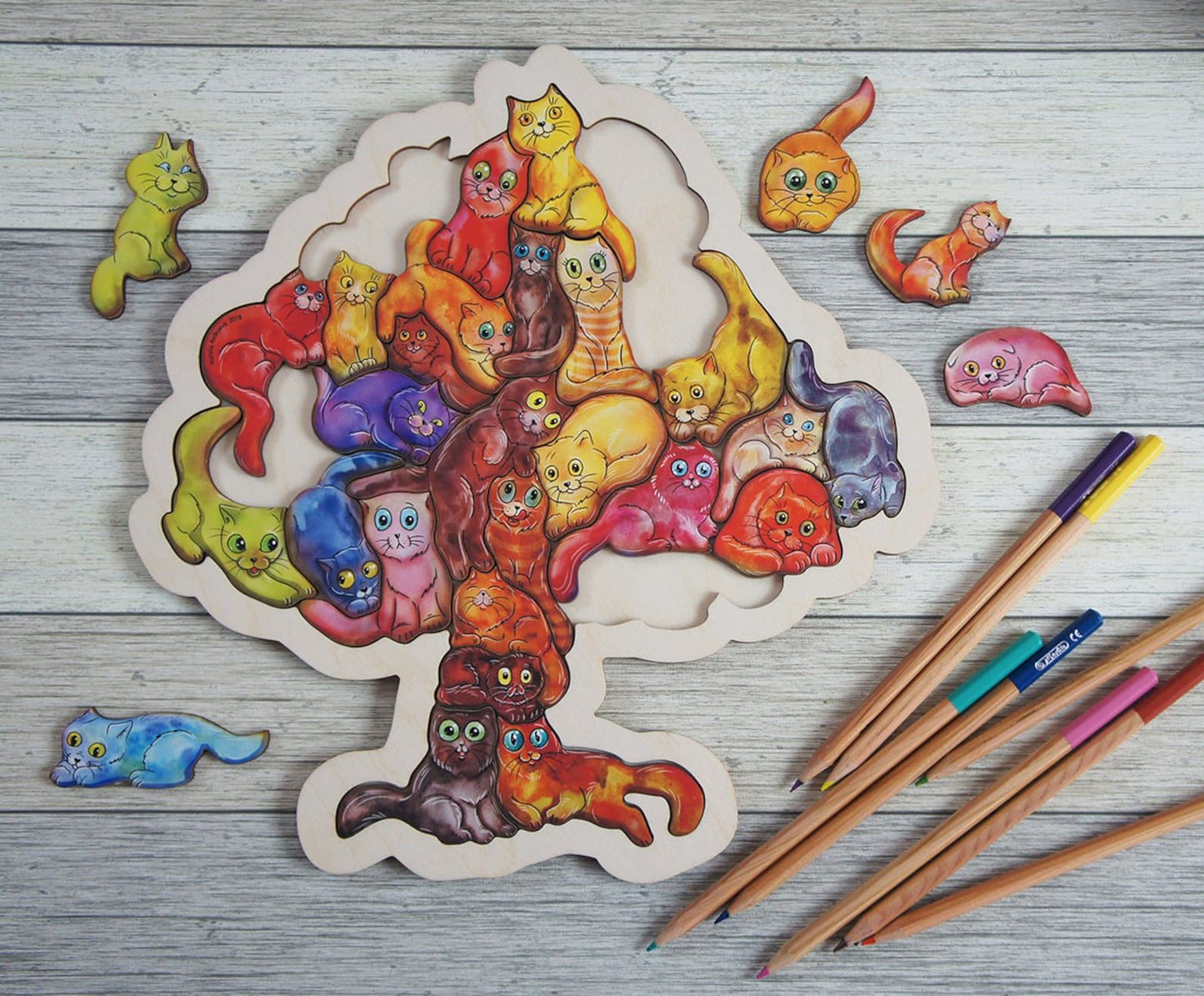
A plywood cat tree with a set of cat figures that come out of it. The frame is the smallest part of what this does — the figures differ from each other in several ways at once, and that is what makes them useful.
Striped or spotted, big or small, different coat colours, different eye colours. A set where every piece differs on several traits lets you run the same activity at four levels of difficulty without buying anything new: sort by one trait, then by two, then guess a hidden one by asking questions, then tell a story with them.
Four ways to work with it
- Sort by one trait, then two. Striped in one group, spotted in another. Then big and small. Then by coat colour, then by eye colour. Once one rule is easy, combine two: small and striped here, small and spotted there. Holding two rules at once is genuinely hard and it is the thinking behind early maths.
- Yes or no. Put seven or eight cats in a row. You pick one in your head without saying which. The child works out which cat you mean by asking questions you can only answer yes or no — "is it striped?", "does it have green eyes?" This is deduction, and it teaches a child to narrow down instead of guessing. Start with four cats, not eight.
- Counting material. Count the cats together, or draw houses and cars on paper and place a set number in each. Counting real objects into a real place builds one-to-one correspondence better than counting pictures in a book.
- Cat stories. Give the cats names and characters, then make up tales about them together. Take turns adding a sentence. A child who resists "tell me a story" will often talk freely when they are holding the character.
What it develops
Classification and logical thinking, deductive reasoning through the question game, visual attention and discrimination, early counting and one-to-one correspondence, vocabulary and narrative language, hand-eye coordination and fine motor control.
Specifications
- Puzzle size: 29,5 × 28 cm
- Material: painted plywood
- For adult-led work: sorting by one trait suits a child from around three, counting from three to four, the yes-no game and storytelling from four to five
A tool for sessions at the table with you, not something to hand over and walk away from. The question game in particular only works with an adult holding the answer.
Share